One Intelligence, Two Orientations

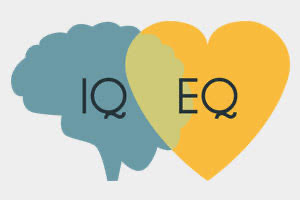
Many studies have offered views on IQ (intelligence quotient) and EQ (emotional intelligence). There was a time when IQ was considered the primary predictor of success. Later, psychologists identified another important use of intelligence and called it emotional intelligence.
I have never been comfortable with the idea of dividing human intelligence into separate kinds of intelligence. It suggests that reason and emotion operate as independent systems with little relation to one another. I do think, however, that there are distinct human abilities worth describing separately.
My way of thinking about IQ and EQ is somewhat devised on my own. Both are important identifications of separate applications of the same faculty: the human mind dealing with reality.
Reality includes many things. We deal with physical objects, ideas, systems, nature, ourselves, and other people. These different aspects of reality require different abilities.
The crucial distinction within the important things we deal with is between human beings and other entities. Human beings make choices. Unlike non-volitional existents, people are not fully determined by their circunstance. They can think, evaluate, and choose differently in the future under same circumstance. That makes human beings significantly more difficult to understand and predict than the rest of things in reality.
IQ and EQ address that crucial distinction. For that reason, I do not see IQ and EQ as different kinds of intelligence. I see them as different uses of same human intelligence.
IQ is the ability to deal with the non-volitional aspects of reality: facts, systems, mathematics, science, technology, abstract ideas, and problems whose solutions do not depend on human choice.
EQ is the ability to deal with volitional beings—including oneself. It is the ability to understand motivations, emotions, values, incentives, and relationships.
Some people possess extraordinary EQ. They read people almost instinctively. They quickly recognize what others want, what motivates them, what they fear, and how to communicate effectively with them. They develop strong self-awareness while becoming exceptionally skilled at building relationships. Many successful politicians, salespeople, negotiators, and leaders possess this ability.
People with very high EQ often devote much of their attention to understanding the people who can positively influence their lives. They accumulate knowledge about other human beings as naturally as scientists accumulate knowledge about nature. Reading people becomes their default orientation. They identify where interests overlap and know how to create mutually beneficial relationships.
I suspect this often begins with an early decision:
> "I will adapt myself to others. I will give people what they want so that I can survive and succeed, because they, in return, will help me obtain what I want."
Using this approach, they start practicing and eventually exceling on their social skills, to later become a high EQ people. A self-sustaining cycle towards even higher EQ and neglected IQ may start to form.
Other people make a very different early choice:
> "I have my own interests. I have my own identity. I will create value according to my own judgment and trade it with those who genuinely want what I create."
These individuals are usually less concerned with gaining other people’s approval. They are more difficult to conform to their social environment. Their focus is primarily on creating new things through their acquired knowledge rather than adapting to other people. They pursue their own interests with passion and devote most of their energy to understand nature and make their ideas real. More and more, if they neglect life’s social aspects they end up believing people are very difficult to handle, and very frustrating. A self-sustaining cycle towards higher IQ and neglected EQ may start to form.
Because the high IQ spend more time creating than socializing, their interpersonal skills are often less developed. They may feel uncomfortable in highly social environments because people simply interest them less than their own discoveries and ideas do.
The highly social person, on the other hand, naturally sees relationships as opportunities for mutual gain. Through people he gains access to knowledge, resources, partnerships, influence, and opportunities. Because he practices these skills constantly, he becomes remarkably good at understanding people. Opportunities seem to appear more frequently for him because he knows how to navigate human relationships.
If such a person also possesses the intellectual ability to solve real problems and create genuine value, he can accomplish remarkable things. He is surrounded by capable allies, many of whom occupy influential positions, while simultaneously possessing valuable skills of his own. His network allows him to recognize opportunities long before most people do.
The fact is that the ability to build relationships with others matter. And the ability to understand nature also matters.
For a long time, I viewed highly connected people with suspicion. I often regarded exceptional networkers as manipulative or even deceptive, believing their success came merely from knowing the right people.
Certainly, some people fit that description. But not all of them.
After years of professional experience, especially working on projects that required genuine collaboration, I realized that dismissing the ability to work effectively with other people was a serious mistake.
Very few worthwhile achievements are accomplished entirely alone. Unless someone is an extraordinary genius working in complete isolation, meaningful accomplishments usually require cooperation.
I grew up oriented more to knowing things than to knowing people. For many years I believed I could rely almost exclusively on technical competence. As long as I remained an excellent subject-matter expert, I thought my work would speak for itself. That approach was sufficient to earn a living, but not to reach higher altitudes. Being an expert was not sufficient to maximize my growth.
The fundamental mistake was believing that building relationships necessarily required sacrificing my integrity. I assumed that the moment I acted with other people's interests in mind, I would begin losing my own identity.
But at this point I simply believe that people are not all-or-nothing, but that does not mean I compromise on my principles.
I may disagree with someone on many subjects while sharing important values and interests in others. I will rarely meet someone with whom I agree completely. In fact, the only person with whom I could ever hope to agree completely is myself—and even that requires constant examination, because I sometimes discover beliefs I acquired long ago that deserve to be challenged.
The goal, then, is not to seek perfect agreement. The goal is to build relationships without surrendering my principles.
That means, to cooperate where values genuinely overlap, and morally judge others based on what they do - to trade with people value for value, and offer them what they deserve.
So it seems to me that that building the necessary skills to maintain one's identity while earning trust, gaining allies, and strengthening relationships is good.
I am grateful that I learned this before it was too late.
Now it is up to me to develop certain skills that I neglected for far too long—not because it lacked value, but because I misunderstood their value.